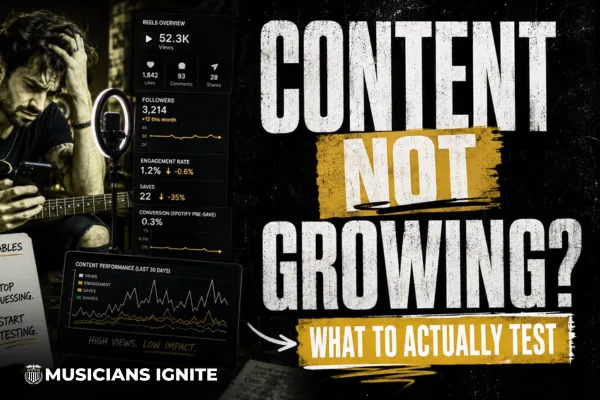
Why Your Music Content Isn't Growing on Social Media (And What to Actually Test)
If you've been posting consistently but your social media isn't growing, the problem probably isn't your music. Most musicians hit a wall not because they lack talent or discipline, but because they keep repeating the same format and hoping for a different result. The fix is a simple three-part testing framework: test your format, test your hook, and drop the expectation that any single post will go viral. Growth comes from data, not from luck.
The Real Reason Social Media Stops Working for Musicians
Here's something worth sitting with.
Peter Drucker, one of the most respected business minds of the last century, wrote a book called Managing Oneself. In it he says most people think they know what they're good at. And most of them are wrong. Same goes for what they think they're bad at.
The only thing that corrects that is feedback.
For musicians on social media, feedback lives in the feed. Which means the only way to actually know what connects with your potential fans is to put content out and watch what happens. Not assume. Not theorize. Test.
But here's where it breaks down for most artists: they don't see their content as tests. They see each post as a performance. Something that either succeeds or fails. Something that reflects on them personally.
And so when a video doesn't perform, they don't think "interesting, let me try something different." They think "I knew it. This doesn't work. I'm not cut out for this."
That's not a social media problem. That's a perspective problem.
The 3-Part Framework: Format, Hook, and Mindset
1. Test Your Format
Format is the packaging. It's the situation your music lives inside on screen.
Think about the difference between these:
You teaching a riff, zoomed in on your fretting hand
You playing a cover of a well-known song but flipping the genre
You showing your music to strangers on the street and filming their reactions
You doing what Small Town Titans did: scanning QR codes, converting the numbers into guitar riffs, and posting the result
That last one is a format they stumbled onto, tested, and then repeated because it worked. It grew them a significant following. Not because QR codes are interesting. Because the format was unexpected, repeatable, and built around their music.
The mistake most musicians make here is looking at what's trending (TikTok dances, challenge formats, etc.) and assuming that's the formula. The problem is those formats attract people who want general entertainment, not people who want to connect with your specific music. You can go viral doing something that has nothing to do with your sound and end up with an audience that will never buy a ticket or a piece of merch.
Your format needs to attract the right people, not just a lot of people.
Some things worth testing:
Casual phone footage vs. produced video
Solo performance vs. behind-the-scenes
Teaching vs. performing
Reaction-based content vs. storytelling
Short and punchy vs. slow and immersive
A client who was getting solid traction with raw, phone-shot videos decided to upgrade to professional editing software and spent hours on cinematic transitions and effects. Views dropped significantly. His casual, garage-style content felt real. The produced version felt like an ad. Fans noticed even if they couldn't explain why.
Simple often wins. Readable always beats clever.
2. Test Your Hook
The hook is the text that appears on screen in the first moment of your video. It is the headline. And it functions exactly like the bold headlines on magazine covers in the '90s: its only job is to make someone stop scrolling.
Two things a good hook does:
Builds curiosity. Gets the viewer asking a question they need the video to answer.
Sets a frame. Gives context for what they're about to see, so the format makes sense the moment it starts.
A few things that don't work:
"Did I just write the song of the summer?" (Overused to the point of becoming a meme)
Anything that can't be read in under two seconds while someone is scrolling fast
Fancy fonts that look great on an album cover but become unreadable at speed
The font itself matters more than most musicians want to believe. Plain, high-contrast, readable text will outperform a beautifully designed font that makes people squint. If even one person has to think "wait, what does that say?" you've already lost them.
Hook formats worth testing:
The curiosity gap: "I played this for 47 strangers. Here's what happened."
The anti-flex: "Every guitarist on here is doing this. I did the opposite."
The list hook: "3 reasons your covers are getting skipped before the chorus"
The story opener: "My band got booed off stage in 2019. Here's what changed."
The polarizing take: "This guitar technique is overrated and I'll prove it."
Note on polarity: the goal isn't to be inflammatory. The goal is to provoke a reaction strong enough that people feel something and engage. The worst place to land is where people feel absolutely nothing and scroll past. Even frustration beats indifference, as long as it's tied to something genuine about your music and your point of view.
3. Get Your Mindset Right
This is less glamorous than tips one and two but it's the one that makes the other two actually work.
When you post content expecting followers, email signups, and sales from a single video, you're going to be disappointed almost every time. And that disappointment is what kills momentum. It's what sends musicians into learned helplessness, where they stop trying because nothing ever seems to work.
The shift is this: post content to collect data, not to collect likes.
Every video is a test. Every test gives you information. Eventually the information tells you what's working. Then you double down on what's working. That's the whole system.
Stop stressing about whether your Instagram grid looks cohesive. Stop deleting videos that didn't perform after three days. Stop spending four hours on a thumbnail your actual fans will never think about. Post. Get data. Adjust. Repeat.
Common Mistakes Musicians Make With Social Media Content
Protecting the persona at all costs. A lot of rock and metal artists won't post anything unless they're on stage with an instrument in hand. Unless you've intentionally built a mystery-driven brand like Sleep Token, the mystique isn't doing what you think. It's just limiting your ability to connect.
Confusing production value with connection. Better cameras and professional editing do not equal more engaged fans. Raw authenticity consistently outperforms over-produced content on social platforms. This doesn't mean your music should sound rough. It means your content can be simple.
Posting for the algorithm instead of for a person. The algorithm is built on human behavior. Make content a real fan would actually stop and watch. The algorithm follows real engagement.
Riding trends that have nothing to do with your music. If someone follows you because of a trend video, they followed the trend. Not you. Not your music. That follower will rarely become a buyer.
Deleting content that didn't immediately perform. Content can sit dormant for months and then get picked up unexpectedly. Every piece you delete is a line you're pulling out of the water before it has a chance to catch anything.
What to Do Next
Look at your last 9 posts. Are they all the same format? If yes, pick two completely different formats and test them this week.
Write 5 hooks for your next video. One curiosity-based. One list-based. One polarizing. One story-based. One anti-flex. Post the one that feels slightly uncomfortable. That's usually the one worth testing.
Commit to a data mindset for 30 days. Post with the only expectation of getting information back. No follower goals. No view minimums. Just data.
Simplify your text overlays. Switch to plain, bold, readable fonts. Prioritize readability over aesthetics every time.
Stop deleting. Leave everything up. Let it work.
Want Help Building a Content System That Actually Works?
If you want one-on-one help figuring out the right formats for your genre, the right hooks for your audience, and the systems that move people from social media into your email list and from your email list into real revenue, click the link below to apply for a free strategy call.
[Apply for a Free Strategy Call]
Watch the full video breakdown here:


