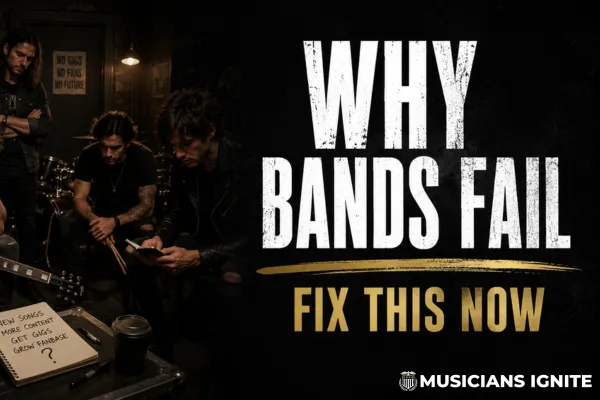
Why Most Bands Fail (And What to Do Differently Before It's Too Late)
Most bands don't fall apart because the music wasn't good enough. They fall apart because the traditional band model is economically broken, and nobody talks about it honestly until someone's already spent a decade finding out the hard way. If you're in a band right now, or thinking about starting one, this article is going to save you years of grinding toward a goal that the old playbook can no longer reach.
The Traditional Band Model Is Broken
Let's do some math nobody likes to talk about.
Your band plays a show. By some miracle, you walk away with $400 for the night. There are four of you. That's $100 each, before you account for gas, food, and the fact that the band itself needs operating capital to grow.
If you're actually running this like a business, you set aside a fifth share for the band fund: marketing, recording, equipment, whatever. Now everyone's walking away with $80.
$80 a night. To cover food, gas, and the hours you spent rehearsing, loading gear, and driving to the venue.
And that's on a good night. In 2025, with inflation making everything more expensive, $80 barely gets four people through a day on the road.
Now multiply that out. To make something close to a livable income from touring alone, at that kind of per-show rate, you'd need to play somewhere between 12 and 20 shows a month, consistently, without canceled dates, without van breakdowns, without venues that double-booked you or simply forgot you were coming.
That last one isn't hypothetical. A booking agency once promised 70 dates in a year. Eleven were actually booked. Four of those were canceled. The venues for two of them had no idea the band was coming at all.
That's the traditional model in practice. And it's not a new problem. It was barely viable in 2013. In 2025, it's genuinely not a workable plan for most independent bands.
Build Online First, Then Tour With Leverage
The instinct when you're in a band is to do what your heroes did. Get in the van, play every room you can get a booking in, grind until someone notices.
Here's the problem with that: when your heroes were doing it, there was no alternative. The road was the only way to build an audience city by city. Playing 300 shows a year was the equivalent of what one well-placed piece of content can do today.
The upside of a live show is real. The connection is potent. The experience is immediate. But if 15 people are in the room, your potential new fan pool is 15. One piece of content that actually connects with the right people can put your music in front of 100,000.
The smarter sequence is: build the online presence first, get people on your email list, create some income from merch or offers, and then use the audience data to tour with leverage instead of hope.
Spotify for Artists tells you which cities your listeners are concentrated in. If you've built up 400 people on your email list and a third of them are in Chicago, you can walk into a Chicago venue and have a real conversation. You can say, "Here's our listener count in your market. Here's roughly how many people we can realistically bring through the door. Here's what the average drink ticket looks like at that number." That's a negotiation, not a prayer.
Without the online foundation, you're just another band asking for a shot. With it, you have leverage.
The Unified Front Framework
Beyond the economics, the other reason bands break up is misalignment. And it almost always goes unaddressed until it's too late to fix.
There are three things every member of a band needs to share before the project has a real chance.
1. Understanding of the business.
Every member doesn't need to be a marketing expert. But every member needs to understand the bare minimum: you need a direct way to reach your fans, a way to alert them when new music drops, and a way for them to financially support what you're building. If some members have no concept of why any of that matters, there will always be friction when business decisions have to be made.
2. Willingness to sacrifice.
What that sacrifice looks like changes as people get older. At 19, taking a low-paying job so you can tour half the year is a reasonable trade. At 32, with a mortgage and kids, the math changes. That's not a character flaw. It's just reality. But if the sacrifice requirements of the band don't match what each member is actually able to give, the band will eventually crack under the pressure of that mismatch. Better to have that conversation before 10 years go by.
3. The same long-term vision.
This one is subtle and it's the one that causes the most damage when it's missing.
Some people join a band with a specific goal: play a big tour, open for one of their heroes, record a real album. And once they hit that goal, they're done. The box is checked. They've lived the dream and they're satisfied.
If the rest of the band is still climbing toward something larger, that member's "done" moment becomes everyone else's anchor. The short-term decisions that make sense when you're aiming at a 10-year goal look completely arbitrary to someone who already feels finished. And the resentment builds quietly on both sides until something breaks.
The fix is simple but uncomfortable: ask every member directly, in a real conversation, what their actual end goal is. Not "make it," not "be successful." What does the finish line look like to them specifically? If the answers don't match, that's important information to have before you've toured together for five years.
The band that tours before they're ready. Four musicians who have been playing together for three months book a regional run. On the second night there's a monitor issue and the vocalist can't hear herself. Two members freeze. The set falls apart and the handful of people who came specifically to see them leave before the encore. Practice until you can run the set on autopilot. Technical problems are inevitable. Your response to them should be automatic.
The band with one business-minded member and three who "just want to play." The one member handles booking, email list, social media, merchandise, and the band fund. After two years, they're burned out, doing the majority of the work, and splitting the money four ways. Either the other three need to step up, or the economics need to reflect the imbalance. This conversation is uncomfortable. Not having it is worse.
The band that tours without audience data. They book a run across six cities, spend $4,000 on van rental, gas, and hotels, and average 23 people per show across the whole tour. Two of those cities had single-digit attendance. If they had checked their Spotify data first, they would have known that four of those six cities had almost no listener concentration. They could have cut the tour to two cities with strong local pull and broken even instead of losing money.
Common Mistakes Bands Make
Touring before building an online presence. The road builds an audience slowly and expensively. Content can build one faster and cheaper. Do both eventually, but in the right order.
Splitting everything equally regardless of contribution. Equal splits feel fair at the start. Over time they create resentment when the workload isn't equal. Build a structure early that reflects what everyone is actually doing.
Avoiding the long-term vision conversation. It's awkward to ask your bandmates where they see this going in ten years. It's much more awkward to have it collapse at year eight because you never did.
Rehearsing until you're "pretty good" instead of until adversity is automatic. Stage disasters happen constantly. If you haven't built the muscle memory to handle chaos, you'll lose the audience the moment something goes wrong.
Comparing your trajectory to bands that came up in a different era. The musicians who built careers by relentless touring in the '90s and early 2000s were doing so in a world where that was the only available tool. You have tools they didn't have. Use them.
What to Do Next
Run the economics honestly. What does your band realistically make per show right now? What would you need per show, per month, to make this viable long-term? If the numbers don't work, the plan needs to change before the effort does.
Have the unified front conversation. Sit down with every member and ask three questions: do they understand how the business works, what they're willing to sacrifice, and what the actual end goal looks like to them. Document the answers.
Build online before touring regularly. Start with content that puts your music in front of new people. Get them on an email list. Track where your listeners are geographically using Spotify for Artists. Let the data tell you where to play.
Rehearse until problems are automatic. Set a consistent weekly practice schedule and hold it for at least six months before booking any serious run of shows.
Check your Spotify data before booking a tour. Find the three cities where your listeners are most concentrated. Build a small run around those instead of hoping audiences show up in random markets.
Want Help Building the Online Foundation Before You Hit the Road?
If you want one-on-one help setting up the systems that grow your audience online, get fans on your email list, and give you real leverage when you're ready to tour, click the link below to apply for a free strategy call.
It's a no-pressure conversation to see if it makes sense. If it does, great. If it doesn't, you'll still walk away with a clearer picture of what to do next.
[Apply for a Free Strategy Call]
Watch the full video breakdown here:


