Why Consistent Posting Isn't Growing Your Music Audience (And What Actually Does)
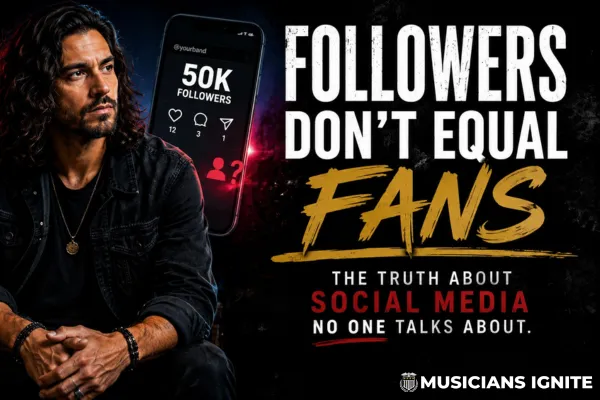
Posting consistently with great music should work. For a lot of musicians it doesn't, and the reason almost never gets talked about honestly. The artists who are actually growing aren't posting more than everyone else. They're posting differently. Specifically, they're building content around three things: visuals people can actually read and watch without effort, a clear picture of who their ideal fan is, and a headline that creates the right frame before anyone even hears a note. Get all three working together and the connection follows. Miss any one of them and the algorithm isn't the problem.
Why "Post More" Isn't the Answer
Here's the fishing pond analogy worth keeping.
Every social media platform is its own pond. Every piece of content you post is a line in the water. More lines in more ponds does improve your odds, but only if the bait on the line is something the fish in that pond actually want. Throw the wrong bait consistently and you're just cluttering the water.
The musicians who post every day and still get no traction aren't posting too little. They're posting without connection. And consistency without connection is just noise.
What creates connection? Three things, in sequence.
The Three-Part Content Connection Framework
1. Visibility and Readability: The Barrier Nobody Talks About
Before anyone connects with your music, they have to be able to see and read your content without working for it.
On the visibility side: your content doesn't need to look like a Netflix production, but it needs to be clear enough that people can immediately understand what they're looking at. Video that looks like it was filmed on a 2006 flip phone gets scrolled past because the brain has to work too hard to decode it. And the moment consuming your content requires more effort than moving a thumb upward, the thumb wins every time.
Here's the counterintuitive part: over-production can work against you too, especially if you're building from a smaller following.
When you have 100,000 subscribers and high-quality cinematic video, that tracks in a viewer's mind. The production matches the authority. But if you have 300 followers and your content looks like a Super Bowl commercial, there's a disconnect. The brain quietly asks: "Why does this look so polished but have no engagement?" It's reverse social proof, the same way a house that's been on the market for 700 days makes buyers nervous, even if the house is beautiful.
The sweet spot is good enough to see clearly, casual enough to feel real. Rehearsal footage with decent lighting. A close-up of your hands on the instrument. Authentic over cinematic, almost every time.
On the readability side: your text hooks need a background behind them so the words pop off the screen. Using the platform's native caption style, plain background with clean text, does two things. It's easier to read at speed. And it looks like a post from a real person, not a sponsored ad. That matters more than most musicians realize. Skepticism is immediate the moment content feels like it's selling something before it's said anything worth hearing.
2. The Fan Avatar: Who Are You Actually Talking To?
This is where most musicians skip a step they can't afford to skip.
Ask a musician who their audience is and the most common answer is some version of "anyone who appreciates good music." That feels humble. What it actually does is guarantee that the content speaks to no one in particular, which means it connects with almost nobody.
Defining your fan avatar isn't about being exclusionary. Taylor Swift has never said metalheads can't listen to her music. But she doesn't build her content around what metalheads care about either. She knows her core audience at a level of detail most artists never bother to develop, and everything she puts out is calibrated to connect with that specific person.
Start with the data you already have. Spotify for Artists and Apple Music for Artists will tell you age ranges, geographic concentrations, and sometimes gender breakdowns of who's actually listening. That's your demographic baseline.
Then go deeper into psychographics: the cultural language, shared beliefs, and day-to-day behaviors of people inside your specific niche.
Metal fans tend to be anti-establishment, highly individualistic, suspicious of mainstream anything. Pop fans, especially in the younger demographics, lean toward optimism, aspiration, and the feeling that anything is possible. Country fans, at least in the red dirt and traditional lanes, are rooted in place, community, blue-collar identity, and a particular relationship with independence. None of these are universal truths, but they're real enough patterns to build content around.
The key question isn't "how do I look cool to these people?" It's "what are they thinking about today, and how does my music fit into that?"
People pay attention to content that moves them toward something they want or away from something they don't. If your content speaks to something already living in your fan's head, it feels like recognition. If it doesn't, it gets scrolled.
3. The Headline: Creating the Frame Before the Music Plays
The text overlay on your video in the first three to five seconds is your headline. Not a hook in the songwriting sense. A marketing headline. Its job is to stop the scroll and create a frame.
The frame matters more than most musicians understand.
A frame is the lens through which someone watches everything that follows. The same 30-second video clip can land completely differently depending on what headline preceded it. Put "I can't believe she did this, so rude" over footage of a waitress picking up a check and the viewer watches every movement for signs of rudeness. Put "I can't believe she did this, so sweet" over the exact same footage and they're looking for the kind gesture. Same visuals. Completely different experience, created entirely by the headline.
For musicians, the frame has a specific job: it puts the viewer in a mental and emotional state where they're most ready to receive the music. The formula is:
Headline creates frame. Frame creates context for the scenario. Scenario is the visual. Music is the soundtrack to the scenario.
A client who plays heavy metal created a piece of content around the scenario of getting home after a rough day at work and needing to destroy something on the guitar. The footage was already shot. The music was already there. The headline created the frame that put the viewer in exactly that state before a single note played. People who have had that kind of day (which is a lot of people) felt it immediately.
An EDM artist who creates music that makes people want to move doesn't just post the track. He creates content framed around being in a space where the only thing that makes sense is to let go and dance. The music becomes the answer to a feeling the headline already activated.
The headline doesn't need to be clever. It needs to be accurate. What feeling does your music create? What scenario does it belong to? Put that in the headline and let the music do the rest.
A musician in the classic rock lane figured this out after months of flat engagement. His music genuinely sounded like it came out of the early '70s. He'd been posting performance clips with no headline at all, just the music. Views were modest and inconsistent.
He added one headline to a video: "Do you remember when guitars sounded like this?" Nothing else changed. Same footage, same song, same quality. That video outperformed everything he'd posted in the previous four months because it spoke directly to a longing his audience already had. The frame, nostalgia for a sound people grew up with, made the music land differently.
That's message to market match. The right words, for the right people, over content that delivers exactly what the frame promised.
Oliver Anthony's viral moment worked the same way. The visual, the setting, the song title, and the lyrics all created one coherent frame that his audience recognized immediately as speaking directly to them. It wasn't an accident. The elements aligned.
What Most Musicians Get Wrong With Content
Posting for themselves instead of for a specific person. Content designed to make the artist feel good about how they look rarely connects with anyone outside the artist's head. The question shouldn't be "does this represent me well?" It should be "does this speak to something my ideal fan is already feeling?"
Using production as a substitute for connection. High-quality video with no emotional hook underneath it is just expensive wallpaper. The production exists to serve the connection, not replace it.
Writing headlines that are vague or self-congratulatory. "New music out now" tells no one anything about what they're about to feel. "When your boss ruins your whole day and you need five minutes of this" tells a specific person exactly what they're getting and why it matters to them right now.
Treating the avatar as a demographic checklist instead of a real person. Knowing your fans are 24 to 35 and mostly male is a starting point. Knowing they're also skeptical of authority, proud of being outside the mainstream, and will immediately distrust anything that feels like it's trying too hard, that's what you actually build content around.
Ignoring the frame entirely. Posting music content without a headline is like opening a conversation in the middle of a sentence. The audience has no context for what they're about to hear and no reason to keep listening.
What to Do Next
Pull up your last five pieces of content. For each one, ask: could someone who has never heard of you understand what they're looking at within two seconds? If not, the visibility needs work before anything else does.
Open Spotify for Artists or Apple Music for Artists this week. Look at your top age ranges, top cities, and any behavioral data available. Write one paragraph describing the average person listening to your music right now.
Write down five things your core fan thinks about or deals with on a regular day. Not what you want them to care about. What they actually care about. Then look for the overlap between that list and your music.
Write three headline options for your next piece of content before you film anything. One based on a feeling the music creates. One based on a scenario it belongs to. One that references something specific to your niche's cultural language. Post the one that makes you slightly uncomfortable because it's so specific. That's usually the one that works.
Test one framed piece of content this week. Headline plus scenario plus music as the soundtrack. Compare the engagement to your last five posts. Let the data tell you whether the frame changed anything.
Want Help Figuring Out Your Fan Avatar and Building Content That Actually Connects?
If you want one-on-one help identifying your ideal fan, building content around them, and setting up the systems that move those fans from social media into your email list and from your email list into consistent income, click the link below to apply for a free strategy call.
[Apply for a Free Strategy Call]
Watch the full video breakdown here:


