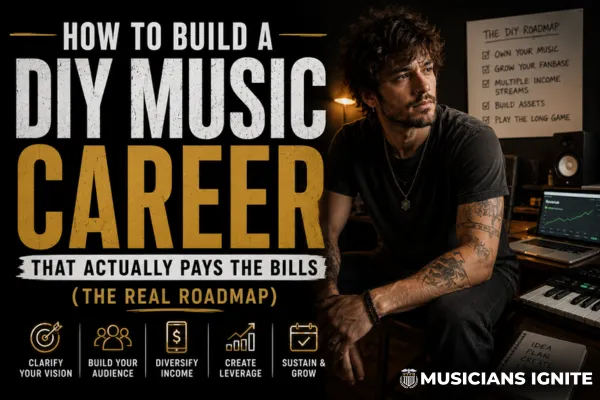
How to Build a DIY Music Career That Actually Pays the Bills (The Real Roadmap)
Most musicians have been handed a broken definition of success, and it's quietly destroying their chances of ever building something real. If you've been chasing Grammy nominations, Billboard placements, or a label deal as your measure of "making it," this article is going to rearrange some things. The actual path to a sustainable music career in 2025 runs through four straightforward business pillars, a $100-$150/month tech stack, and a willingness to redefine what winning looks like. None of it requires a label. Most of it fits in your phone.
Start Here: The Success Trap Nobody Warns You About
John Mayer had a friend who sold 2 million records at a time when that was nearly unheard of. By every industry metric, this person had made it. And they were miserable.
That story lands differently when you actually sit with it. Not because success is hollow, but because the definition of success this person had chased didn't match what they actually needed to feel like their life was working.
The music industry has been incredibly effective at selling a very specific picture of success: Grammys, late night TV appearances, radio spins, arena tours. That picture exists to funnel musicians into a system that profits from them, not one that sustains them. Labels have a long, documented history of signing artists, running up costs charged against the artist's royalties, and leaving them to pay off debt from sales that were technically "successful."
Prince wrote the word "slave" on his face. TLC sold millions of records and nearly went bankrupt. These aren't edge cases. They're what happens when the industry's definition of success gets accepted without question.
Here's the question worth asking instead: what would actually make your life work?
For most musicians, if you asked them honestly, the answer isn't an arena tour. It's something more like: enough monthly income from music that I can quit the day job or at least cut it to part-time. Enough financial stability that I'm not stressed every month. Enough freedom that I control my own schedule.
That's the real goal. And it's achievable without a single label deal, a single radio spin, or a single Grammy nomination.
Why DIY Is the Future (And Why This Moment Is Uniquely Good)
Back when labels dominated everything, they had control over things nobody else could access: relationships with radio programmers, connections to major venues, distribution networks that moved physical product into stores. If you wanted any of that, you needed them.
That infrastructure has been democratized.
For somewhere between $100 and $150 a month, a musician today can run an entire music business with tools that would have cost tens of thousands of dollars to build just 15 years ago.
Content editing software (CapCut, iMovie, Captions): free or near-free. Email service providers with free entry tiers (MailChimp and others): free to start. Merchant accounts and print-on-demand merch (Shopify, Stripe, Printful, Printify): low monthly cost or percentage-based. Website and funnel builders (Wix, Squarespace, System.io, ClickFunnels): $20-$50/month depending on the plan. Automation tools that cross-post short-form content to every platform simultaneously: around $25/month.
For about what someone might spend on a gym membership and a couple of streaming services combined, the full technical infrastructure for a music business can be operational. That's extraordinary compared to any previous era.
The musicians who are doom and gloom about the current industry tend to be comparing it to a version of the industry that also had artists writing "slave" on their faces and selling millions of records while heading toward bankruptcy. The old model wasn't a golden age. It just looked like one from the outside.
The Four Pillars of a DIY Music Business
Once the tools are in place and success has been redefined as something achievable, these four pillars are the actual operating framework.
Pillar 1: Lead Generation
A lead is anyone who might want what you're offering. For a musician building an original act, that's a potential fan. For a music teacher or producer, that's a potential client.
The job of lead generation is to move the right people from "never heard of you" to "want to know more." Content is the primary vehicle. The format that works varies by niche and audience. The key is testing consistently until something clicks, not repeating the same format that isn't working just because it feels comfortable.
Once someone is curious enough to want more, the next step is getting them into a list you own. Email or SMS. Not just a social media follow. A lead magnet helps: an unreleased track, a free download, a resource that's genuinely worth having in exchange for an email address. Even a simple micro-pitch works: "If you want behind-the-scenes stories and early access to new releases, join the list."
The goal of this entire pillar is to get the right people into direct communication reach where no algorithm stands between you and them.
Pillar 2: Customer Acquisition
"Customer" is a word that makes some musicians uncomfortable. It doesn't have to be. Someone who has bought 47 Coca-Cola products and owns three Coca-Cola shirts is both a fan and a customer. The two things aren't in conflict.
Customer acquisition is the process of turning a warm lead into someone who has actually made a purchase. A wristband. A digital download. A ticket. A merch item. The first transaction.
The first purchase is the hardest. After that, everything gets easier, because you've proven that this person is willing to support you financially, and the relationship is real.
One launch for a single included a $7 offer for a signed CD through a simple email sequence. Of the people who bought the $7 item, 100% of them also took a $37 upsell for a t-shirt and signed poster bundle. The average transaction went from $7 to $44. The entire advertising cost for the campaign was covered, with profit left over.
That result isn't magic. It's what happens when the offer is right and the audience is warm from good storytelling before the ask is made.
Pillar 3: Customer Ascension
Once someone has bought something, the question shifts from "how do I get them to buy?" to "how do I give them more to invest in?"
Ascension means moving customers up a value ladder from lower-priced items to higher-priced ones. A $5 wristband leads to a $30 t-shirt. A $30 t-shirt leads to a $75 VIP experience at a show. Each step increases lifetime customer value, the total amount a single fan contributes to the business over the entire relationship.
The fans who buy a $7 item are almost always willing to buy a $37 item if it's offered immediately and the value is clear. The fans who buy the $37 item are often willing to buy a $97 item if the experience is there. Every customer who gets a great experience becomes a higher-value customer when the next offer is made.
The ascension ladder doesn't need to be complicated. Two or three tiers, each with genuine value, is enough to meaningfully increase what the business generates from its existing audience.
Pillar 4: Continuity (Monthly Recurring Revenue)
This is the pillar that builds financial stability instead of just one-time spikes.
For musicians, continuity most often looks like a fan club or Patreon. Fans pay a monthly fee ($5, $9, $15, $17) in exchange for ongoing access, exclusive content, early releases, or other benefits. One band ran a fan club at $17/month (keeping $15 after processing fees) and found that the recurring income created a predictable floor that made the entire business more stable.
For music instructors, continuity looks like monthly lesson packages instead of pay-per-session. Charging at the start of each month for a set of four lessons, rather than collecting after each individual session, not only creates predictable income but also increases the likelihood students show up. They've already paid. They want the value they committed to.
One client left a corporate guitar teaching job where they needed 35 to 40 clients per week to hit their income target. In their private practice with monthly recurring packages, 7 to 9 clients covered the same income. That's the efficiency difference between owning a recurring revenue model versus selling time one unit at a time.
A musician who had been doing pay-per-lesson teaching for three years with inconsistent income decided to switch to monthly packages. She set a flat monthly rate for four lessons. Within 60 days, she had 11 recurring students paying monthly. Her income became predictable for the first time. She was able to plan, save, and invest back into her music without the constant uncertainty of whether the next week would be light.
Nothing about her teaching changed. The music didn't change. The offer structure did.
What Most Musicians Get Wrong About Going DIY
Defining success as what the industry wants them to chase. Billboard placements and radio spins are the scoreboard from a game that profits the people who run the machine, not the artists playing in it. Build toward income that makes your actual life work.
Waiting until everything is perfect before starting. The tools available right now are genuinely good enough. A $25/month automation tool and a free email service provider is more infrastructure than most musicians had available at any price in 2010.
Skipping the recurring revenue step. One-time sales create spikes. Monthly recurring income creates stability. The floor is what makes everything else possible.
Treating fans and customers as separate categories. Fans who buy things are both fans and customers. Accepting money from people who genuinely want to support you isn't a betrayal of the relationship. It's the natural conclusion of providing real value.
Building the fan business before the skills business. The instructor or producer route generates income faster than building a fan base large enough to generate equivalent revenue from merch and tickets. If speed to income matters, the skills-based path is more direct. Both can run in parallel over time.
What to Do Next
Write down your actual income goal. Not a Grammy. Not arena tours. The monthly number that would let you quit your job or cut it to part-time. Then do the math on what combination of products, services, or offers would reach that number.
Audit your current tech stack. Content editor, email service provider, a way to accept payments, a place to send people. Identify the gap between what you have and what you need, then fill the most critical one first.
Set up one lead magnet this week. An unreleased track, a PDF, a performance video. Something genuinely worth having. Build the opt-in. Start pointing content toward it.
Make one offer to your email list in the next 30 days. If you don't have an offer ready, build the simplest one that makes sense for your audience. A warm list with no offer is goodwill that's slowly cooling off.
Add one recurring option to your business. A fan club. A monthly lesson package. A retainer for production clients. Something that generates the same income month after month without requiring a new sale each time.
Want Help Implementing All Four Pillars?
If you want one-on-one help setting up the lead generation system, the offer structure, and the recurring revenue model for your specific music business, click the link below to apply for a free strategy call.
[Apply for a Free Strategy Call]
Watch the full video breakdown here:


