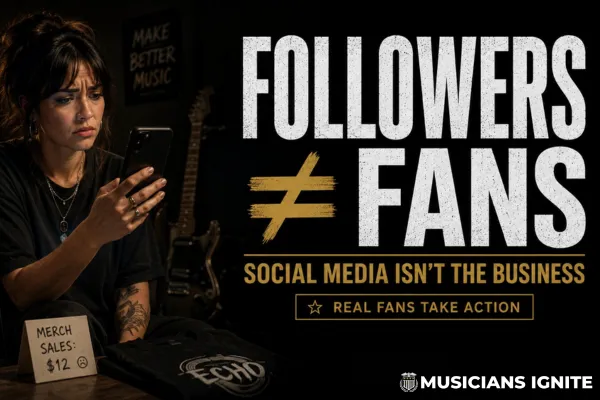
Followers Don't Equal Fans: Why Social Media Isn't What Most Musicians Think It Is
If you're chasing follower counts and wondering why nothing is converting into actual income, the problem isn't your music, your consistency, or the algorithm. The problem is a fundamental misunderstanding of what social media is actually for. Followers and fans are not the same thing, and treating them as if they are is what keeps musicians with growing audiences and zero sales. Social media has one job: get the right strangers into a list you own. Everything else flows from that.
The Million Follower Problem No One Is Talking About
There is a musician who reached one million TikTok followers.
Not 10,000. Not 100,000. One million people chose to follow this artist on a single platform.
And when asked how much income that following had generated, the answer was zero dollars.
Think about the work that goes into building a million-follower account. The consistency, the time, the creative energy, the emotional investment in every post. All of it, real. All of it, genuinely impressive. And completely disconnected from income because the conversion side of the equation was never built.
This isn't an outlier. It's the pattern. And the reason it keeps happening is that most musicians were handed a single metric (follower count) as the definition of success on social media, and never questioned whether that metric actually meant anything for their business.
It often doesn't.
Growth vs. Conversion: The Two Sides Nobody Tells You
Building an audience on social media has two completely separate phases, and almost everyone focuses on only one of them.
Phase one is growth. Getting new people aware of you. Getting your content in front of strangers who have never heard your music. This is where most musicians spend all of their energy, and it's not wrong to focus here. You do need new people to find you.
Phase two is conversion. Taking the people who discovered you and moving them from passive awareness into something real: an email list, an SMS list, a contact you actually own. A follower you can reach without asking a platform for permission.
Most musicians get people into their world and then keep trying to get more people into their world. The funnel fills at the top and empties out the bottom because there's no mechanism moving anyone anywhere.
Here's what the data actually shows. Two email lists, roughly the same size, both around 2,000 subscribers. One gets 25 to 34% open rates. The other gets less than 1%. Same platform, same size, completely different results. The difference isn't the list size. It's the quality of the audience and whether real connection was built before the ask was made.
Volume without connection is just noise. A thousand people who genuinely care about your music are worth more than a hundred thousand who vaguely remember seeing one of your videos.
The Three-Layer Social Media Framework
Layer 1: Social Media Is for Cold Traffic, Not Your Existing Fans
Here's something most musicians do that silently kills their content performance.
They create content for the people who already know them.
They start videos with "Hey everyone, it's [artist name] from [band], and today we're..." Nobody who has never heard of you is going to stay for that. The moment the content assumes familiarity, the people who don't have that familiarity (which is the vast majority of people seeing any given post) are gone.
Check your analytics right now. Look at the ratio of followers versus non-followers watching your content. For most independent musicians, it runs somewhere between 70/30 and 90/10 in favor of non-followers. The algorithm is almost entirely pushing your content to strangers. If you're creating content that only makes sense to people who already know you, you're creating content for 10% of your actual audience.
Social media is cold traffic territory. Create every piece of content as if it's being seen for the very first time by someone who has never heard your name. Start with the thing they care about, not with who you are. Earn their attention before you introduce yourself.
Layer 2: Drive Action Toward a List You Own
Once someone sees your content and it connects, the next question is: where do they go?
Most musicians have no answer to that question. The connection happens and then it just floats. The person scrolls on. Maybe they follow. Maybe they don't. Either way, they're still on someone else's platform, subject to someone else's algorithm.
The goal isn't to get a follower. The goal is to get a contact.
Email lists. SMS lists. Something where you have the information directly and no one can take it from you. Not even the biggest creators on YouTube own their subscribers. If the platform shuts them down tomorrow, those subscribers go with the platform. What stays is whatever list they have outside of it.
The content on social media should always have a next step that moves people toward a list. A lead magnet, an exclusive track, a reason to give you their email that's worth more to them than the mild inconvenience of signing up. Once they're on the list, the relationship you build from there is yours completely.
Layer 3: Build the Deeper Bond Inside Your List
This is where most musicians have no idea what to do, because nobody talks about it.
There are two levels of how a fan knows an artist.
The first level is surface: they've seen the content, they recognize the name, they've heard a song or two. Real, but thin. At this level they're a casual observer. They might buy something if the offer happens to land at exactly the right moment, but they're not invested.
The second level is story: they know where you came from, what you went through to get here, what it actually costs you to do this thing you do. They know you're not a brand. They know you're a person. When someone asks them about their favorite artists, your name comes with a story attached, not just a sound.
That second level is built inside the email list, through content that would feel too personal for social media. The origin story. The real version of why you started making music. The moment you almost quit. The thing nobody talks about in interviews. All of it belongs in the emails that go to the people who already like you enough to have given you their address.
When you eventually have something to offer those people, and you ask them to support what you're building, they're not buying from a stranger. They're supporting someone whose story they've been living alongside. That changes everything about how they respond.
A musician with 340 email subscribers had never once sent an offer to her list. She sent updates about shows and new releases, treated the list like a newsletter, and assumed the people on it already knew her well enough.
Open rates were around 11%. Not terrible. But nothing was converting.
The fix was a three-email sequence that told her story. Not a polished bio. The real version. Where she grew up. How she got started. The specific moment she decided to take the music seriously. By the third email, she made one offer. A limited merch bundle tied to her first proper release. Response rate on that email was more than double anything she had sent before.
The list hadn't grown. The offer wasn't new. The only thing that changed was that the people on the list finally knew who they were buying from.
What Most Musicians Get Wrong With Social Media
Treating follower count as the success metric. Followers are a starting point, not a destination. The only metric that tells you whether social media is working is whether people are moving from the platform into a list you own.
Creating warm content for a cold audience. Talking to your existing fans on social media is like hosting a dinner party and spending the whole night talking to the people you came with. The strangers in the room never get to know you.
Starting content with an introduction. "Hey everyone, it's [name]..." signals to every cold viewer that this content wasn't made for them. Lead with the thing that matters to them, not with who you are.
Building the audience but skipping the offer. An email list with no offer is just a collection of names. The list exists so you can eventually give people a way to support you. If you never make the offer, the list never pays off.
Confusing surface-level engagement with real connection. Likes and follows feel like validation. They're not the same as someone who would buy a ticket, support a crowdfund, or tell their friends about your music. Real connection is built through story, not through consistent posting.
What to Do Next
Check your analytics this week. Find the follower vs. non-follower breakdown on your top-performing posts. Let that number reset your assumption about who is actually watching your content.
Audit your last 10 posts for cold traffic readiness. Would a total stranger understand and care about each post within two seconds? If not, lead with what they care about before getting to who you are.
Set up one list entry point. Pick a lead magnet (an unreleased track, a performance video, anything genuinely exclusive), build a simple opt-in, and start linking to it from every piece of content you post.
Write your origin story. Not the polished version. The real version. Where you started, what pushed you to keep going, what it actually cost you. This belongs in your welcome email sequence and it does more for conversion than any discount or giveaway.
Send one story email this week. To whoever is already on your list. One real story about why you do this. No pitch. Just connection. Watch what it does to open rates and replies compared to your usual updates.
Want Help Building the Full System From Social Media to Sales?
If you want one-on-one help setting up the content strategy, list-building system, and email sequence that takes people from strangers to buyers, click the link below to apply for a free strategy call.
[Apply for a Free Strategy Call]
Watch the full video breakdown here:


