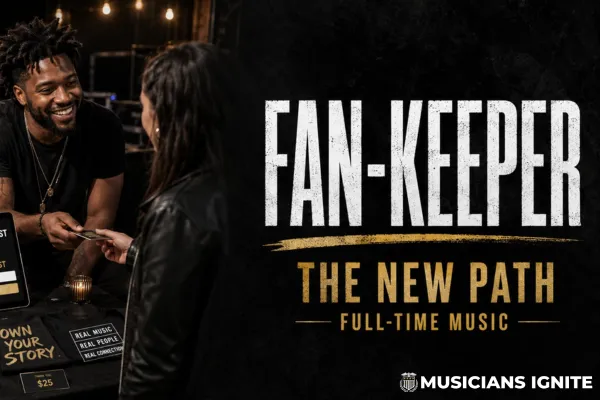
From Gatekeeper to Fan-Keeper: The New Path to a Full-Time Music Career
Most musicians are still building toward a career that no longer exists. The old path, getting signed, having a team handle the business, and focusing almost entirely on the music, has been replaced by something that requires more from the artist but also gives more back. The musicians who are actually going full-time right now aren't waiting for a label to discover them. They've figured out a three-step system: identify the right audience, own the contact information, and give fans a way to support them. That's the entire new model.
The Old Path (And Why It's Gone)
For most of the 20th century, breaking into music as a career meant getting past gatekeepers.
Record labels. Radio programmers. Industry managers. You couldn't even get a conversation without a referral from someone already inside the network. The game was almost entirely about who you knew, and if you managed to get through the door, you were handed a team. A manager, a publicist, a booking agent, people who handled the business side while you focused on the music.
The rough split back then was about 80/20. Eighty percent of your energy went into writing, recording, and performing. The other twenty went into interviews, press, and music videos.
That infrastructure is largely gone now. What replaced it isn't better or worse, it's just different. And the musicians who are struggling are the ones still trying to operate the new model with the old mindset.
There are artists still working today who got grandfathered into the old model, who blew up before streaming dismantled the industry and have been riding those relationships and that infrastructure ever since. That's not a criticism. But if you didn't break through in that era, you and those artists are playing completely different games. And pretending otherwise is what's costing most independent musicians years of unnecessary frustration.
UPDATE: Your Fans Are the New Gatekeepers
Here's the shift that changes how you see everything.
The labels used to decide who got heard. Now the fans do. And the algorithm, which everyone blames for their lack of growth, is just a reflection of how fans actually behave on these platforms. It isn't a mysterious enemy. It's a measurement tool. Feed it content that real fans engage with and it finds more of those fans. Feed it content nobody responds to and it stops showing it to people.
Which means the energy that used to go toward schmoozing industry insiders now needs to go directly toward understanding and serving your actual audience. Same total effort. Different direction.
The other big shift is the ratio. What used to be 80% music and 20% business is now closer to 50/50. That's genuinely harder. And for musicians who haven't figured out efficient systems yet, it can tip even further toward the business side, which is where burnout comes from. The musicians who thrive in the new model are the ones who build systems that make the business side repeatable and fast, so they can get back to the music.
The good news: the technology available to independent artists right now is extraordinary compared to even five years ago. Free platforms. AI tools that can help draft emails from a voice note in ten minutes instead of staring at a blank screen for 45. Streaming analytics that tell you exactly which cities your listeners are concentrated in. All of it exists to help artists build their own economy, one that doesn't require a label's permission or a radio station's playlist.
The 3-Step New Path Framework
Step 1: Identify Your Audience (For Real This Time)
Ask most musicians who their audience is and they'll say something like "anyone who likes good music." That answer sounds humble. What it actually means is they haven't thought about it.
This isn't about being exclusionary. Taylor Swift doesn't say metalheads can't listen to her music. But she doesn't center her marketing around what metalheads care about either. She knows her core audience deeply: their values, their relationship with music, the moments in their lives her songs speak to. That specificity is what makes the marketing work.
For your music, this means going beyond genre. What does the average person in your audience actually care about? What are the cultural touchstones, the shared experiences, the phrases and references that signal belonging to your niche? When you know those things, you can build content that pulls those people in, because you're speaking directly to something already living in their head.
The content you create from that understanding becomes the top of your funnel. It's how strangers discover you. Not through a label or a radio station, but through an algorithm that's just measuring whether real people like what you're putting out.
Step 2: Own Your Audience (Stop Renting It)
Here's a number worth sitting with.
Out of a thousand musicians who are seriously trying to build a music career, maybe ten have an email list. Maybe one has an SMS list. The rest are renting their audience from whatever platform they post on.
Renting means: if the algorithm changes, you lose reach. If the platform gets banned or goes down, you lose access. If you get flagged or suspended for any reason, you lose the connection entirely. It happened to creators who built hundreds of thousands of followers when Instagram shifted to interest-based algorithms. Overnight, their reach dropped and they had no backup.
Owning means: an email list or SMS list where you have the contact information directly. No middleman. No algorithm between you and your fans. You send a message, they get it.
The system for getting there is straightforward. Create content that attracts the right people. Give them a compelling reason to hand over their email address (something free, exclusive, and genuinely worth having). Get them onto a list you control. Now you have an audience, not just followers.
Step 3: Give Fans a Way to Support You
This is the step most musicians skip, and it's the one that actually creates income.
Once someone is on your email list, the worst thing you can do is nothing. They signed up because they're interested. That interest has a shelf life. The longer you wait to offer them something, the more that initial excitement fades.
Here's how to think about the offer so it doesn't feel like selling: you're not pushing product at people. You're creating a vehicle for fans who already want to support you to actually do it.
Think about it from the fan's side. They've found your music. They like it. They're on your list. At some point, they'd genuinely like to do something that supports the artist they've been listening to. Your job is to give them that something. A merch item that connects to the world your music creates. A VIP experience at a show. A fan club membership. A signed limited item.
When the offer is right and the relationship has been built through good content and genuine communication, people say yes not because you sold them hard but because you gave them a way to do something they were already inclined to do.
Once that system is in place and working, the loop becomes self-sustaining: fans support you, you keep creating and giving them things to be excited about, they support you more.
The original artist with no email list. Has been posting consistently for two years. Solid engagement on some posts. Zero way to reach those fans directly if Instagram changes its algorithm tomorrow. The fix: pick one lead magnet (an unreleased track, a performance video, anything genuinely exclusive), set up a simple opt-in page, and start pointing content toward it. 200 real fans who gave you their email are worth more than 8,000 passive followers.
The musician who has a list but has never sent an offer. Built up 340 email subscribers over six months, sends occasional updates, never sells anything. The subscribers have essentially gone cold because there's been no reason to stay engaged. The fix: a re-engagement email that tells a real story, followed by a simple offer that gives them a way to support the next project. Not a hard pitch. A genuine invitation.
The artist afraid to niche down. Keeps their content broad because they don't want to "exclude anyone." Their engagement is flat because nothing they post speaks specifically to anyone. The fix: identify the three or four cultural touchstones that define their most passionate listeners and build content that speaks directly to those things. The core fans will find it faster and stick harder.
Common Mistakes Musicians Make With the New Model
Trying to use the old 80/20 split in a 50/50 world. Spending nearly all your time on music and almost none on the business side doesn't work anymore. The business side has to be treated as real work, not an afterthought.
Building on rented land. Followers on any platform are borrowed. One algorithm change, one policy update, one account suspension, and the access disappears. Build toward owning the contact information.
Waiting until the list is "big enough" to send offers. 74 people on a list can generate $1,500 if the offer is right and the relationship is real. There's no minimum audience size required to start.
Creating content for everyone. Content that tries to reach everyone reaches no one with any depth. Pick your core audience and speak directly to them.
Saying "out now" instead of "listen now." Small but real. "Out now" tells fans what you did. "Listen now" tells fans what to do. One is artist-centric. The other is fan-centric. In the new model, everything tilts toward the fan.
What to Do Next
Write a one-paragraph description of your core fan. Not "music lovers." A specific person: age range, what they do on weekends, what they care about, what phrases and references would signal to them that you get their world.
Set up one lead magnet. Pick something exclusive and genuinely valuable and build a simple opt-in around it. Start pointing your content toward it this week.
DM your last 30 new followers. Thank them personally. Start a real conversation. At some point mention the lead magnet and move them from platform to list.
Design one core offer. Something every fan of yours should have. Make it specific to the world your music creates. Price it fairly. Make it easy to buy.
Set up an automated welcome sequence. When someone joins your list, they should hear from you immediately with a warm message, the thing you promised them, and a path toward that core offer.
Want Help Setting Up the Full System?
If you want one-on-one help building the audience identification, list-building, and offer system that actually moves musicians toward full-time income, click the link below to apply for a free strategy call.
Just a conversation. No pressure. You'll walk away with a clear picture of what to do next regardless of where things go.
[Apply for a Free Strategy Call]
Watch the full video breakdown here:


