What Would Musicians Do If Spotify Disappeared? How Artists Can Survive Without Streaming
I want you to imagine something with me for a second.
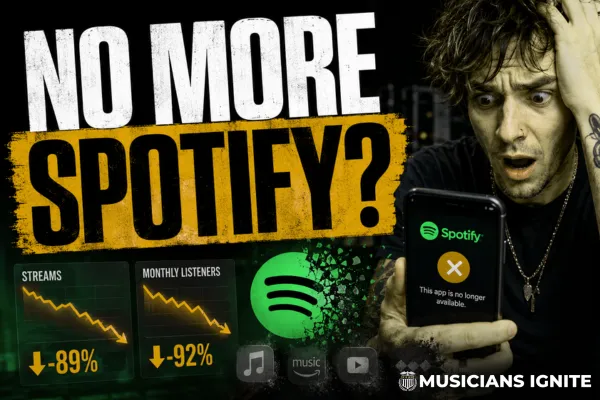
You wake up tomorrow morning. You open your phone, pull up Spotify, and... nothing. The app just sits there. Spinning. Then you get a notification. Not from Spotify, but from a news alert.
Spotify is gone.
Not glitching. Not down for maintenance. Gone. Bankrupt. Servers dark.
Now here's the question I really want you to sit with: what happens next?
Because when I ask musicians this, I get two kinds of reactions. The first group kind of... smiles. Like justice finally got served. Good riddance to the platform that built an empire off the backs of artists and paid them fractions of a fraction of a cent per play.
I get it. I really do.
But then I ask them the follow-up question: "Okay, so what do you do the day after?" And that's where it gets quiet.
Stay with me here, because this is where it gets interesting.
Let's actually look at the numbers, because most of the Spotify conversation skips them entirely.
Spotify is a publicly traded company. You can pull up their balance sheet on Yahoo Finance right now. When you do, here's what you find: roughly 70% or more of their total expenses are royalty payouts. To artists. And despite being one of the most recognized tech brands on the planet, they are operating in the red.
So when people get excited about bills like the Livable Wage Act for Musicians (which would force streaming platforms to pay one cent per stream), I understand the impulse. The instinct is right. The math, though, is a problem.
If Spotify is already losing money while paying the royalty rates they pay now, what happens when you triple that expense? The most likely answer is: they raise prices, kill the free tier, and accelerate their own collapse. Maybe not tomorrow. But the trajectory is not great.
So let's say the worst happens. Spotify actually goes under.
Here's what I think plays out as I talked about in The Real Reason Music Doesn't Make Money Anymore.
Spotify currently has over 500 million users. Apple Music has somewhere around 60 million. Those are not interchangeable numbers. When half a billion people lose their streaming home overnight, they are not calmly migrating to Apple and pulling out a credit card.
Over 60% of Spotify users are on the free tier. So the majority of those 500 million people have never paid a single dollar to listen to music. Are they suddenly going to subscribe to Apple Music at $10 a month?
Most of them are going to YouTube.
And here's the part that should land hard: YouTube's royalty payout is worse than Spotify's. Significantly worse. We're talking about a payout rate that has four or five zeros before you get to an actual number.
So the utopian version of this story, where Spotify dies and artists suddenly start getting paid fairly? The math doesn't support it. In almost every realistic scenario, streaming royalties stay the same or get worse.
I know. Not what you wanted to hear.
But here's the thing, and I mean this genuinely: once you really absorb that, something useful can happen. Because the question stops being "when will the platforms finally do right by us?" and starts being "what do I actually control?"
A few years ago I started looking at Spotify's financials and thinking: this is a MySpace moment.
Remember MySpace? At one point you could not imagine a world where MySpace wasn't the dominant social platform. Everyone was on it. You could customize your page with HTML. You had a song that auto-played when someone visited your profile. It was the whole thing. And then Facebook showed up, quiet and boring and without any of the fun stuff, and slowly everyone just... left.
Same pattern. A platform dominates. A new thing comes. The old thing fades or falls.
The musicians who got hurt most when MySpace died were the ones who had built everything on top of it. The ones who survived? They had something no platform could take from them.
As I brought up in my blog Followers Don't Equal Fans, they had an email list.
This is the part of the conversation most people skip because it's not as emotionally satisfying as arguing about royalty rates. But I'm going to tell you it anyway.
Direct marketing, specifically building a list of fans whose contact information you own, is the only music business strategy that doesn't depend on any platform staying alive.
Think about what that actually means. If Instagram folds, you lose access to your followers. If TikTok gets banned, same thing. If Spotify goes dark, those streams stop. But if you have 4,000 people on your email list? You wake up the next morning, open your email software, and you still have 4,000 people you can reach directly. Today. Without asking an algorithm for permission.
And you can send them your music. Literally just attach the file and hit send. No platform required.
Here's the other piece that doesn't get said enough: the music creates the bond that most businesses have to work extremely hard for. A company selling accounting software has to earn trust from scratch every single time. You? If someone genuinely connects with your music, the bond is already there. You just have to show them what you have available. A ticket. A merch bundle. A VIP experience. You're not really selling them anything. You're showing them a way to support something they already love.
Speaking of VIP, let me tell you something that happened with my own band.
You may remember this from 'What Is A Musician's Product?', but we put together our first VIP offer for a local show. Soundcheck access, acoustic performance, Q&A, VIP parking, early merch table access, lanyards, a merch bundle. The whole thing. And when I told the band we were going to charge $70 for it, they looked at me like I was out of my mind.
"We're not that big. Who's going to pay $70 to see us? Maybe $30. Maybe $40."
We charged $70. Seven people bought VIP tickets. And when the gates opened, there were people trying to get in asking if there were any VIP spots left. Standing at the entrance going "please, can we still get one?"
And we were standing behind them like, "I don't know if we're good enough to be doing this."
The demand was already there. We just didn't believe it existed.
That's the thing about direct marketing systems: they don't create demand out of thin air. They reveal demand that was already sitting there, waiting for you to give it somewhere to go.
So here's where I want to leave you.
Whether Spotify sticks around for another 25 years or goes the way of MySpace next Tuesday, the answer for your music business is the same. Build the systems that let you reach your fans directly. Attract the right people. Give them a way to support you. Follow up. Repeat.
When you have that, no platform death can touch you. You're not beholden to any algorithm, any royalty rate, or any corporate boardroom making decisions that were never made with you in mind.
The control is closer than most musicians think. It's not out there somewhere waiting for a law to pass or a platform to do the right thing.
It's already in your hands.
If you'd like help actually building these systems (the fan-getting side, the selling side, the follow-up side), You can apply for a free call here. It's just a quick conversation to see if it's a fit. No pressure either way, but if you're serious about this, it's worth 30 minutes to find out.


