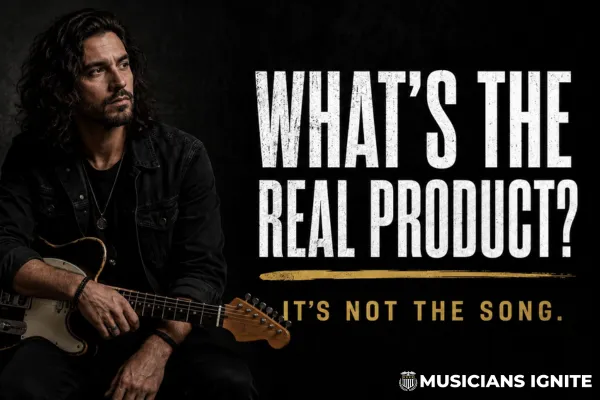
What Is A Musician's Product? (It's Not What You Think)
If you're a musician trying to sell your music and wondering why nobody's buying, the answer is simple: your music is not your product. In the streaming era, fans have already paid for your music through their Spotify or Apple Music subscription. Trying to sell it back to them is a losing battle. Your music is your marketing. Your brand is what builds the connection. And the products tied to that brand are what actually generate income.
Why Musicians Keep Getting This Wrong
Ask almost any independent musician what their product is and they'll say the same thing.
"My music."
It makes sense on the surface. You're a musician. You make music. Music is the product. Simple.
Except it hasn't been true for about 20 years, and operating a music business from that assumption is one of the fastest ways to stay broke while working extremely hard.
As I explained in-depth in The Real Reason Music Doesn't Make Money, here's the basic economics of why.
100,000 songs are uploaded to Spotify every single day. Not every week. Every day. The supply of music is so astronomically large that the demand cannot come close to matching it. When supply dwarfs demand that dramatically, the price of the commodity collapses. That's not Spotify being evil. That's just how markets work.
And then there's the other piece: fans already paid for your music. They paid $10 or $16 a month to their streaming service and got access to your catalog as part of the deal. In their mind, they bought it. So when you try to sell them a CD or a digital download, you're asking them to pay twice for something they already feel they own.
That's why music-centric offers underperform. Not because your music isn't good. Because the consumer behavior has fundamentally changed and most musicians haven't caught up to it yet.
Your Music Is Your Marketing, Not Your Product
Think about what marketing is actually supposed to do.
It's supposed to create a bond between you and the person you're trying to reach. It goes out into the world, someone consumes it, and if it connects, they feel something. They lean in. They want more.
Now think about what your music does.
Someone hears your song for the first time while driving. They replay it. They pull it up later that night. They send it to a friend. They're building a relationship with you through the music, without you being in the room, without you saying a single word about buying anything.
That's not a product being sold. That's marketing doing its job.
The shift is this: your music goes out and builds affinity for your brand. Your brand is the story your fans want to live inside. And then the products tied to that brand are what you actually sell them.
Look at Taylor Swift. Like her music or not, her marketing is worth studying. She puts out music consistently, the music creates a deep bond with her fans, and then what does she sell at the merch table? Clothing. Jewelry. Merchandise that extends the brand experience. Not just the album. The album is what got them there. The brand is what keeps them spending.
The Brand-First Product Framework
Once you accept that your music is the marketing, the next question is: what's the actual product?
I described it in more detail in Why Music Isn't The Product, but here's where most musicians freeze: because they expect a universal answer. There isn't one. The product depends entirely on the brand.
Step 1: Define your brand as a lifestyle, not a genre.
Your brand is the story your fans want to live inside. It reflects their identity, their values, their daily life. A stoner metal band's fans are living a very different daily life than a red dirt country crowd. A female pop artist building a cosmetic line has a different fan avatar than a virtuoso guitarist whose audience is other guitar players.
Ask yourself: what does the average person in my audience do every day? What do they buy anyway? What's the version of that thing with your brand on it that they'd actually want?
Step 2: Match the product to the lifestyle.
A band called Kane Hill used to joke onstage that buying merch helped them buy weed. They were unapologetically a stoner metal band and their fans loved them for it. So what did they sell at the merch table? Grinders. And people bought them immediately, because the product fit the lifestyle the brand represented.
Some examples by genre to get the gears turning:
Country / red dirt: Trucker hats, koozies, bottle openers, belts, custom boots, branded spurs
Rock / metal: T-shirts, limited-run prints, signed broken cymbals, guitar picks in bulk, branded rolling trays
Pop / lifestyle artist: Cosmetics, clothing collabs, jewelry, candles, branded apparel
Gospel / Christian: Hoodies and shirts with original lyrical phrases or abstracted scripture, devotional items
Instrumental / jazz: High-end prints, vinyl pressings as collector items, branded notebooks or gear accessories
Notice that CDs appear on almost none of those lists. Not because CDs are inherently bad. But because for most fans in 2025, a CD isn't a music purchase anymore. At best it's memorabilia. And if that's how your fans see it, merchandise it like memorabilia: signed, limited, numbered. Not as the core product.
Step 3: Let the music do the selling for you.
Music creates a bond that most companies have to spend years and millions of dollars building artificially. A software company earning customer loyalty has to earn every inch of it through service, consistency, and time.
You? If your music connects with someone on a deep level, they're already halfway sold on anything you put in front of them. You don't need to be a hard-charging salesperson. You just need to show them what you have and make it easy to say yes.
The music earns the trust. The brand creates the context. The product gives fans a way to express that they're part of something.
The country artist who has been releasing music for three years and can't figure out why nobody's buying the albums. Her fans stream everything. They know every lyric. But the $12 album on her website just sits there. The fix: a branded trucker hat with her signature phrase on the back, sold at every show and pushed in her email list. Something her fans would buy and wear to the feed store. That's the product.
The rock band whose merch table is stacked with CDs and a couple of generic black shirts with their logo. Their fans buy one shirt if they're feeling generous. The fix: three shirt designs with different energy, a limited-run item tied to the current album cycle, and a VIP bundle for the next show that includes early access, a group photo, and one of the limited items. That's a product suite.
The producer generating inconsistent income from selling beats one at a time. The fix: a monthly retainer where artists pay a smaller amount each month that builds toward their next session. Predictable income for the producer, a lower barrier and higher commitment from the artist.
Common Mistakes Musicians Make With Products
Selling music as the core product. As I outlined in, Why Most Bands Fail, music-centric offers consistently underperform compared to brand-aligned merchandise and experience-based offers. The data on this from working with independent musicians over the past decade is pretty clear.
Waiting to have the product figured out before building the audience. The two should develop together. The music and content tell you what resonates with your fans, and that tells you what to build.
Selling generic merch with just a logo on it. A logo on a black shirt rarely builds identity. The product should feel like it belongs to the world your music has created.
Thinking selling is beneath the art. Entrepreneurs have been part of the entertainment industry since the word was invented. Literally. Your favorite artists sold t-shirts. They were artists and businesspeople at the same time, and one didn't cancel out the other.
Using yourself as the model for what fans want. Musicians buy music education, instruments, and gear. Most of your fans don't. Think about what the average person in your fan base is spending money on in their daily life.
What to Do Next
Write down your brand in one sentence that has nothing to do with your genre or sound. What's the story your fans want to live inside?
List 5 things your average fan buys every week. Not your fans who are musicians. The everyday people who just love your music.
Find the overlap between those everyday purchases and your brand story. That overlap is your product.
Retire the CD as your core product. If you want to sell it, sell it as a memorabilia item: signed, limited, meaningful.
Start with one non-music product and test it at your next show or in your next email. See what happens.
Ready to Build a Music Business That Actually Generates Income?
If you want help figuring out your brand, your product suite, and the systems that connect your music to real revenue, click the link below to apply for a free strategy call. We'll look at where you are right now and map out what actually makes sense for your specific situation.
[Apply for a Free Strategy Call]
Watch the full video breakdown here:


