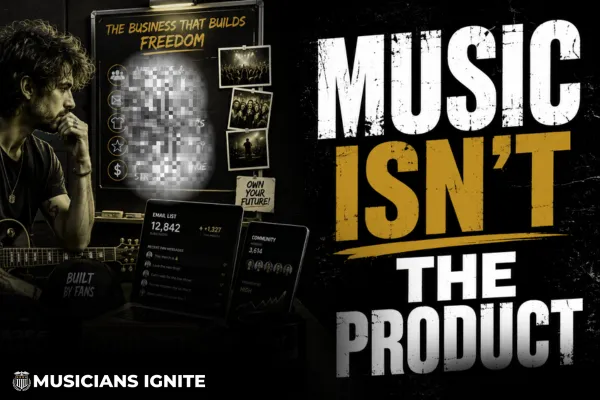
Why Music Isn't The Product Anymore, How Musicians Can Earn Outside of Their Music
I want to start with a question that most musicians get wrong.
Not slightly wrong. Completely, fundamentally, upside-down wrong. And answering it incorrectly is, as far as I can tell, probably the single biggest reason musicians stay broke while doing everything right.
Here it is: what is your product?
Go ahead. Answer it.
If your answer was "music," you're in good company. You're also in trouble.
Here's the thing nobody wants to say out loud, because it bruises something we've all been holding onto. I touched on this in a little more depth on The Real Reason Music Doesn't Make Money Anymore:
Music used to be a product. A real one. You made it, you pressed it onto something physical, and people gave you money for it. Vinyl, cassettes, CDs. For decades, that was the engine. The big houses, the tour buses, the rock star lifestyle you grew up watching, all of it was built on the back of physical media sales.
And then Napster showed up.
And then LimeWire. And FrostWire. And everything else. And the entire consumer behavior around music changed overnight. People figured out they didn't have to pay $17 for a CD with 10 songs, two of which they actually liked. The internet handed them an alternative and they took it.
Eventually Spotify cleaned that up. Made it legal, made it easy, charged $10 a month for access to everything. And now we're in a world where your music is available to anyone on earth, for free, at any hour of the day, forever.
That is not a world where music is a product.
That is a world where music is marketing.
Stay with me, because I know that sentence might have just made something in you flinch.
Here's what marketing is supposed to do: create a bond between you and the person you're trying to reach. That's it. You put something out into the world. Someone consumes it. They feel something. They think, "this person gets it. This is for me." And now they're pre-sold before you've said a single word about buying anything.
Now tell me: what does your music do?
Someone hears your song for the first time and something clicks. Maybe they replay it three times in a row. Maybe they pull it up when they're driving at night. Maybe they send it to a friend. They're building a relationship with you through the music, without you having to be in the room.
That is what marketing does. Your music has been doing it the whole time. You just weren't calling it that.
The difference between that framing and the old one matters more than it might seem. Because when music is your marketing, you stop trying to protect it and you start letting it work. You put it everywhere. You don't gatekeep it. You don't pull it off Spotify to "make it scarce." Keeping your music off Spotify because you disagree with their payout model is like refusing to let your business show up on Google because you don't like their ad pricing. The fans who want to find you need somewhere to look. Spotify is where they look.
Let the music go do its job. Create the bond. Earn the attention.
And then, once you've got it, you actually have something to sell them.
Here's the part nobody teaches.
If music is your marketing, what's the product? I have the full system in my blog, How To Build A DIY Music Career, but here is the simplified idea:
Four buckets. That's it. If you've got something in all four, you've got a real music business.
Bucket one: the giveaway.
This is how you get their contact information. Something free, something easy for you to deliver, something genuinely useful or interesting to them. A PDF, an mp3 of an unreleased track, a behind-the-scenes performance video, a tab sheet if you teach guitar. Whatever makes sense for your world. They give you their email. You give them the thing. Now you can reach them directly, without any platform's permission.
Bucket two: the core offer.
This is the thing every one of your fans should have. Not every fan will buy it, but when they see it, they should feel a little left out if they don't. Think of it like a badge of belonging. The wristband you hold up at every show. The trucker hat if you're in the red dirt country world. The branded rolling tray if your fans are the stoner doom metal crowd. The hoodie with the line on it that hits exactly right if you're a Christian artist with a gift for writing.
The point is it creates community identity. People see it and want in. Keep it to one or two things. Don't overcomplicate it.
Bucket three: the premium offer.
This is where you start making real money. A VIP ticket for your next show. A private listening party. A coaching package if you teach music. A multi-song mixing deal if you're a producer. Something higher-priced, higher-value, for the fans who want more.
My band's first VIP was $70. Soundcheck access, an acoustic set, a Q&A, VIP parking, early merch access, lanyards, a bundle. My bandmates thought nobody would pay it. Seven people bought immediately. More were at the gate asking if spots were still available.
The premium buyers are already in your audience. They just need something to buy.
Bucket four: the continuity offer.
This is the one that changes everything for a music business. A monthly recurring payment. Patreon. A fan club. A lesson package if you teach. A producer retainer where the client pays you a set amount each month that builds up toward their next session.
One of the smartest variations I've seen on this: a producer charges $500 a mix, but offers a $50/month retainer where every dollar paid builds toward the next session. Client shows up after four months owing $300 instead of $500. They feel like they got a deal. The producer got paid during months when no work was done. Everyone wins.
Recurring revenue turns a music business from a hustle into a foundation.
Now here's the thing I want to be honest with you about, because some people will hear all of this and still feel a little weird.
There's a version of the "true artist" narrative that says commerce corrupts the music. That selling things means you've sold out. That if you're hawking merch, you're no longer a real artist.
I'll say this plainly: the people who write those books, give those talks, and make those arguments? They sell things too. The guy making the case that you can't be commercially successful without losing your artistic soul, he has a book. With a price. In a store. The irony is almost too perfect.
Your favorite musicians sold t-shirts. They sold tickets. They sold posters and lighters and guitar picks and VIP experiences. They did that because getting paid isn't a betrayal of the music. It's what lets the music keep existing.
The incentive argument cuts deeper than people realize. When music is directly how you get paid, the pressure to make music for money starts bending what you make. When music is your marketing and your income comes from other offers, you make music because you love it. The art gets to stay pure. The business takes care of itself through a different channel.
That's not a compromise. That's actually the better deal.
So four buckets. A giveaway that gets them on your list. A core offer that builds community. A premium offer that rewards your most committed fans. A continuity offer that gives you recurring income every month.
That's the product. That's what you're actually selling.
The music is out there, doing its job, building the bond, finding the people who are going to care.
Let it work.
If you want help figuring out what goes in each of those four buckets for your specific situation (your genre, your audience, your goals), apply for a free call. We'll map it out together and you'll walk away with an actual game plan.


