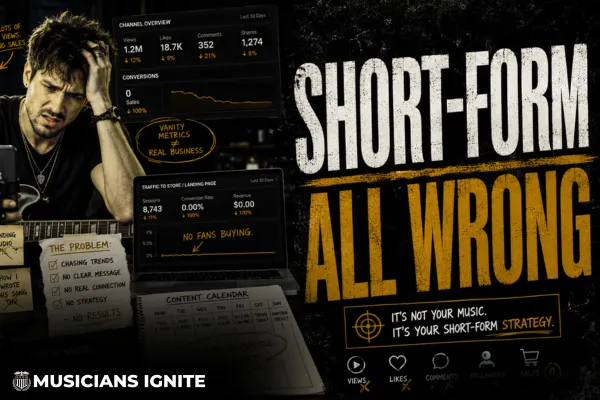
Why Musicians Are Looking At Creating Short-Form Social Media Content All Wrong
I want to tell you about a video I almost didn't post.
It was two years ago. Eleven minutes long, talking about fan-building strategy. I uploaded it, watched the view count sit at 94 for about eight weeks, and felt that particular kind of dread that comes from pouring something real into the internet and hearing crickets.
I thought about pulling it down probably four or five times.
I didn't. And I honestly can't tell you exactly why. Maybe I just forgot about it.
Then one random Tuesday, about 23 months after I uploaded it, the thing jumped to 16,000 views in a week. The algorithm did something I still don't fully understand, and suddenly people were commenting, subscribing, messaging me. From a video I'd considered deleting.
I think about that a lot. And I think about all the musicians I've talked to who deleted their stuff.
Because here's the thing: when you delete a video that isn't performing, you're not cleaning up your feed. You're pulling a fishing line out of the water.
Stay with me.
Let me back up, because there's something I want to say before we get to the fishing metaphor, and it's something that's been bothering me a little.
There is a word that makes a lot of musicians flinch. Maybe you felt it yourself.
"Content creator"
The moment someone tells a musician they need to "become a content creator," something shuts down. Because in our heads, that phrase brings up a very specific image. Someone on TikTok in their car reviewing a bubble machine. Or some guy with perfect lighting eating wagyu beef and trying to look important. Or the fitness influencer who's somehow also selling supplements, a course, and a coloring book.
That's not you. That's not what you're doing. And the mismatch between that image and your actual life as a musician is so jarring that it makes the whole thing feel stupid.
But here's what I want you to sit with for a second.
In 1987, if your band was good enough and lucky enough to land a music video on MTV, nobody called you a "content creator." They called you an artist. A musician. Someone getting exposure. And what was that music video? A piece of content. Distributed through a platform. Designed to pull people in and make them want more.
The platform changed. The phones in everyone's pockets replaced the television in everyone's living room. The concept didn't change at all.
You are not becoming something new by making videos or posting reels. You're doing what musicians have always done to build an audience. The channel is just different.
And once that clicks, the whole thing stops feeling like a betrayal and starts feeling like a tool.
Now here's where most musicians go wrong with that tool.
They start making content for the platform instead of for the people.
The platforms want watch time. They want shares. They want the algorithm-friendly behavior that keeps people scrolling. And they are very good at making you feel like that's what you should be optimizing for. Post at these hours. Use this trending sound. Do the challenge. Ride the wave.
And every time you do that, you feel a little more like you're serving a machine that doesn't care about you at all. Because you are.
Here's the shift: stop making content to please the platform. Start making content to build a connection with a specific human being.
Not "my audience." A person. The kind of person who would genuinely love what you do.
If you're a country artist, that person just got some kind of bad news and they're driving home with the windows down. What does that feel like? What are they thinking about? What song do they need to hear right now? What story would make them feel like someone gets it?
Start there. Make the thing for that person. The platform is just how it gets delivered.
The irony is that content made from genuine connection almost always performs better than content engineered for the algorithm. Because people can tell the difference, even when they can't articulate why.
There's one more piece to this that I think is worth understanding, because it changes how you think about every single thing you post.
Social media is the top of the funnel. That's all it is. I detail that process from follower to fan here inside my blog, From Gatekeepers To Fan-Keepers.
Most of the people seeing your content have no idea who you are. They've never heard your music. They don't know your name. You're a stranger appearing on their phone for about three seconds before they decide whether to keep watching or keep scrolling.
That's not a criticism. That's just the math of cold traffic.
And the mistake most musicians make is they post content that assumes familiarity. "Hey guys, it's Dax from Kirra, just wanted to check in and let you know we've got a show coming up..." and you've already lost 90% of the people watching, because they don't know Dax, they don't know Kirra, and they have no reason to care yet.
As I detailed in Why Consistent Posting Isn't Growing Your Music Audience, cold traffic (i.e. people who don't know you or have never heard of you) needs a reason to keep watching before they need to know your name.
Speak to something they already care about. A feeling. A situation. A frustration. A moment they recognize from their own life. Meet them there first. Bring them into your world second.
Then, once they're interested, give them somewhere to go. A free community. A close friends list. A group. Some next step that moves them closer to you without asking much of them.
And then, from there, move them toward your email list. Because that's the only audience you actually own.
Think about this: if Instagram disappeared tomorrow, you'd lose access to every follower you have on Instagram. But your email list? That's yours. No algorithm decides who gets to see your message. No platform can shut it off. You send it, they get it.
That's the difference between renting an audience and owning one.
So back to the fishing line.
Every piece of content you post is a line in the water. Every platform is a different pond. Your job is to get as many lines in as many ponds as you can, and then leave them there.
The fisherman who pulls his line out after five minutes because he hasn't felt a bite yet goes home empty. The fisherman who casts 47 lines across six ponds and lets them sit for two years eventually finds out which ones work, because the catches come in and he can see the pattern.
Don't delete the videos. Don't pull the lines. Leave them in the water, keep casting new ones, and stay curious about what's getting bites.
You're not trying to go viral. You're trying to find the people who are already looking for exactly what you make. There are more of them than you think. They just haven't found the right line yet.
If you want help building the systems that actually move fans from social media down into your email list and from your email list into real supporters, apply for a free call. We'll figure out what makes sense for your specific situation and you'll walk away with a real game plan.


